Temple Elite Concrete works as a concrete contractor in Cameron, TX, with 20+ years of driveways, patios, slabs and flatwork behind us. Cameron is the one city on our list where the usual regional advice is actively misleading, because the ground under most of the town is not what the ground a few counties over is, and a slab here tends to fail for a completely different reason.
The dominant soil is Minwells fine sandy loam, covering 62.5 percent of the city area in the Milam County soil survey, survey area TX331. Its surface horizon runs from the ground down to about 9 inches at 63 percent sand and only 13 percent clay, and directly beneath it sits a horizon at 42 percent clay. There is no gradual transition. Sand stops and clay starts.
That boundary is where slabs here get into trouble. It is not the seasonal heave the wider region is known for; it is water arriving through a permeable surface layer, reaching a layer it cannot pass through, and sitting there under your concrete. Getting a Cameron slab right is mostly a decision about what to do at nine inches.
What Is Actually Under a Cameron Driveway
Minwells Fine Sandy Loam, and Where It Ends
Minwells is classified as a fine, mixed, active, thermic Udic Paleustalf, and the profile tells the whole story. The A horizon runs 0 to 23 centimeters, about 9 inches, at 63 percent sand, 13 percent clay, a plasticity index of 8 and a linear extensibility of 1.0 percent. That upper layer is friable, easy to dig and almost inert as far as slab movement goes.
Immediately below it the Bt1 horizon runs from about 9 to 20 inches at 42 percent clay, a plasticity index of 30 and a linear extensibility of 4.8 percent. Two horizons, one boundary, and completely different material on either side of it.
Plasticity Index 8 Over Plasticity Index 30 at Nine Inches
A 22 point jump in plasticity index across a single horizon boundary is a large change to meet at exactly the depth most flatwork excavations reach. A driveway or patio cut of 9 inches lands squarely on the clay while the spoil coming out of the hole is sand, which is a genuinely confusing site to read if you are working from what came out rather than from what is left.
That is the practical trap. Judging the subgrade by the excavated material tells you about the layer you removed, not the layer you are about to build on, and the two are as different here as any two soils on this list.
The Permeability Collapse at That Boundary
The change in water behavior is even sharper than the change in plasticity. Saturated hydraulic conductivity falls from 28 micrometers per second in the sandy A horizon to 1.0 micrometer per second in the Bt1, a twenty-eight-fold drop across nine inches.
That number explains the failure mode. Rain moves easily down through the sand and then effectively stops, so water perches on top of the clay, which is to say directly under a slab bearing on that horizon or on the sand just above it. Saturated support, softened bearing and a slab that rocks or cracks follow from there, and none of it looks like the heave story people expect in this part of Texas.
Looking for concrete-contractor closer to Belton? See Concrete-Contractor in Belton.
The Two Subgrade Decisions, and Which One a Cheap Quote Assumes
Cutting Through to the Clay
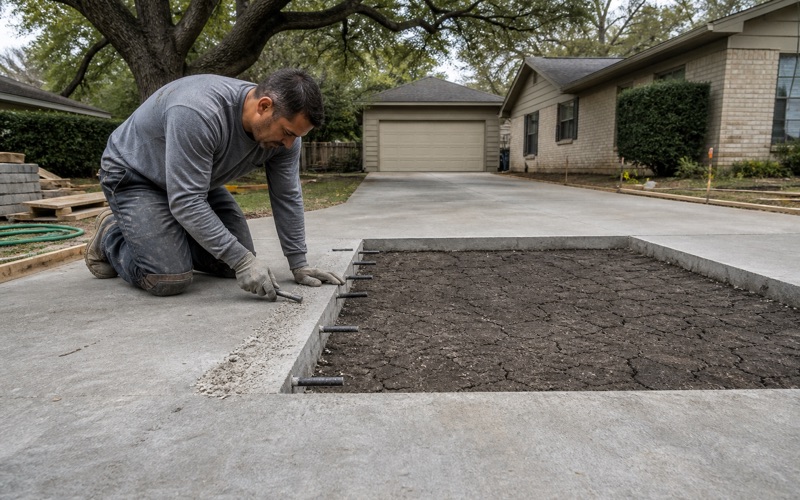
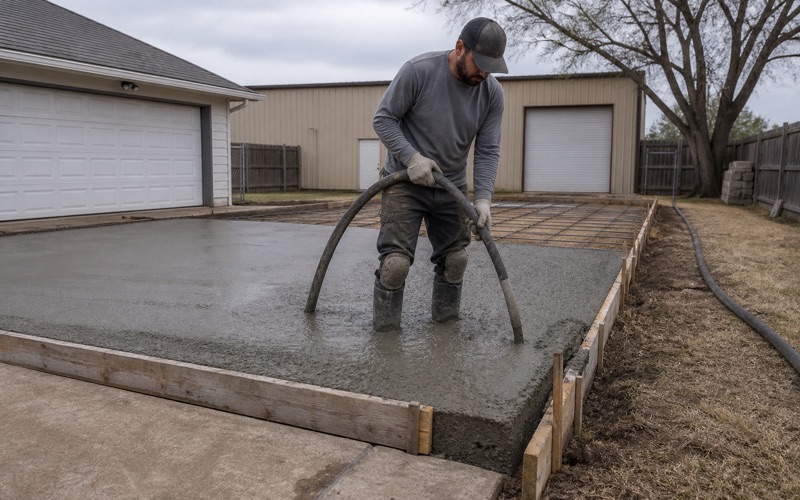
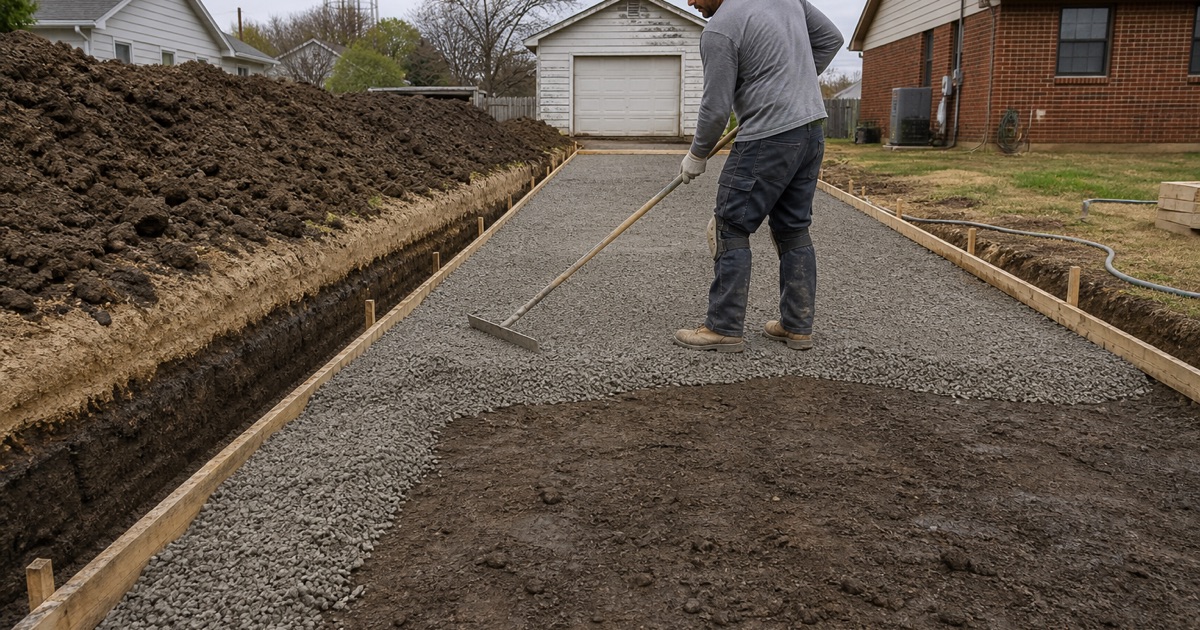
One approach takes the excavation down through the sand and builds on the clay itself. That gives a firmer, more consistent bearing layer, and it puts the slab on material that does not simply wash and settle. What it also does is put the slab on a plasticity index of 30, which needs the subgrade prepared, moisture-conditioned and drained rather than simply graded flat.
Leaving the Sand in Place
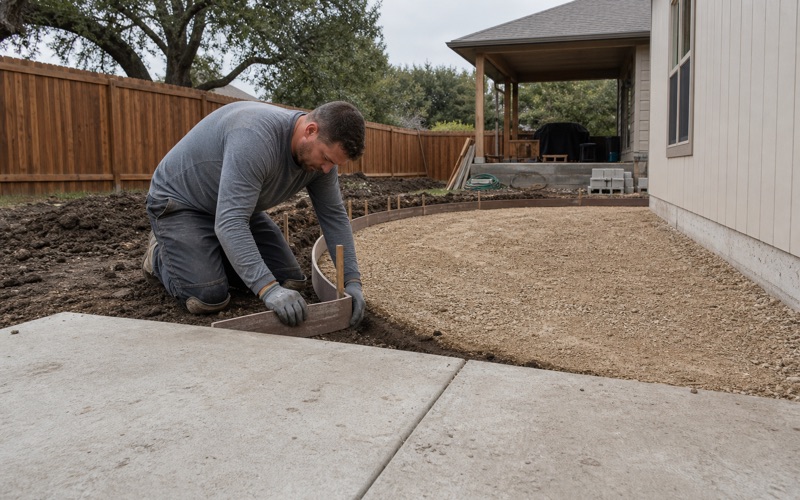
The other approach keeps a shallower cut and builds on the sandy layer. That is easier, quicker and cheaper on the day, and it works where the drainage is genuinely handled, because sand is a perfectly good bearing material when it stays where it is and stays drained.
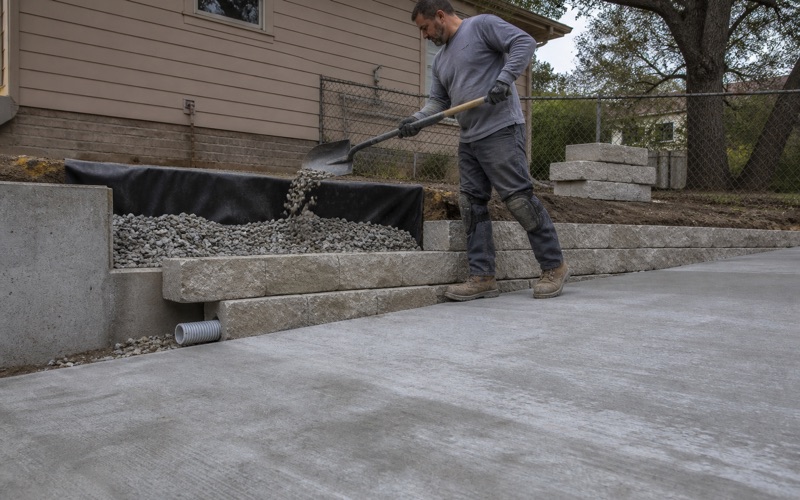
The risk is what sits underneath. A friable sandy subgrade over an effectively impermeable layer will perch water, and water in that position moves fines around and takes support out from under the edges of a slab. So the shallow cut is not wrong, it is conditional, and the condition is drainage that was actually designed rather than assumed.
Where the Heavier Clay Really Is in Town
Not all of Cameron is Minwells, and the parts that are not matter. Branyon clay covers about 6.1 percent of the mapped city area at a plasticity index of 39 in the surface horizon and 43 below at 13 percent linear extensibility, and Houston Black clay a further 5.4 percent at a plasticity index of 44 and 12 percent linear extensibility.
The Wilson-Davilla complex adds about 9.2 percent, and it is the same shape of problem as Minwells with a shorter sand layer, with Wilson carrying a plasticity index of 16 at the surface and 32 below. So the town is a mosaic rather than a single condition, and reading the specific lot is the only way to know which of these three pictures applies to your driveway.
No Rock, and What That Takes Out of an Excavation Quote
No Lithic or Paralithic Contact Within Two Meters
Here is a piece of genuinely good news that most of the surrounding cities do not get. Across every map unit clipped to the city boundary, the only restrictive layers recorded anywhere are densic, at 114 centimeters and 163 centimeters, and no component records a lithic or paralithic contact within 200 centimeters.
In plain terms there is no rock under Cameron at any depth a flatwork job reaches. Excavation is not priced by rock here, which removes the single largest source of quote variability we deal with in cities to the west, where a machine can stop moving a foot down.
What Still Drives the Excavation Price
With rock off the table, the variables are depth, disposal and drainage. How deep the cut goes is a design decision rather than something the ground imposes, which means it is a decision you should expect a contractor to explain rather than one they can blame on conditions.
There is a local convenience worth knowing about as well: aggregate is dug close by, with sand and gravel plants working Little River alluvium on county roads with Cameron addresses. The material a slab is poured with comes from a few miles away rather than a long haul.
Where the Rubble Goes
Disposal is the item that does not come free. The city’s dump fee schedule opens by stating that no commercial or industrial users or collection vehicles are allowed, so a contractor tearing out a driveway is hauling that rubble somewhere else entirely.
That is a real cost on any replacement job in this city, and it is one that quietly disappears from a low quote. We price disposal as its own line so you can see it, because a number that does not include it is not a number for the job you are actually asking for.
Permits, Registration and the One-Year Hold
The Permit That Does Not Exist, and the One at the Property Line
There is no flatwork, driveway or patio permit in Cameron and no line for one anywhere in the fee schedule. A building permit is required to erect, construct, enlarge, alter, repair, move, improve, remove, convert or demolish a building or structure, and porches, patios, decks, carports and sheds are priced only when they are under roof. An uncovered slab on private property is not a named permit category.
The property line changes everything, though. Work in the street or right-of-way requires a permit for excavation, for construction activity, for a permanent structure occupying right-of-way and for temporary obstruction, each with a design plan submitted for review beforehand. The construction and excavation permits each carry a $250.00 minimum fee plus a $50.00 per month inspection fee, with a $2,000.00 bond for construction activity, excavation and cutting work.
Building Contractor Registration and the Bond
A concrete contractor working here registers as a building contractor. The city requires a license from anyone engaging in the business of structural construction or alteration, at $50.00 per year running January through December with no proration, together with a $1,000.00 surety bond, and the city accepts proof of liability insurance in place of that bond.
That registration is worth checking, and it comes with a lever a homeowner can actually pull. A contractor who fails to correct defective work after notice from the city inspector is refused any other permit until the defects are corrected, and faces revocation of the license for continual defective work. Since Texas issues no state license for concrete contractors, this is the credential to ask about here.
The Codified Slab Design and the One-Year Obligation
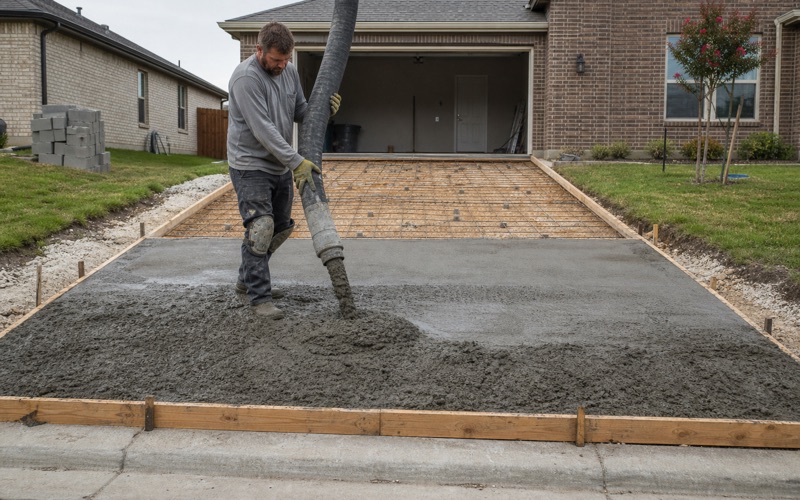
Cameron is unusual in writing a slab specification into its own code for work in the street. Where a slab goes over a trench, the code calls for fill installed in six-inch layers each compacted to 95 percent density, a six-inch concrete slab extending 12 inches past the trench on each side with its top 2 inches below the surrounding paving, reinforcement with six-inch by six-inch number 6 wire mesh supported to sit approximately equidistant from the top and bottom surfaces, and High Early Type III portland cement making 2,500 psi concrete at three days, cured and closed to traffic per state specifications.
The obligation afterward is equally specific, and fairer than it first looks. A permittee must keep the work in good, sound, smooth and serviceable condition free from all cracks and defects for not less than one year from completion, with an explicit carve-out that cracks appearing in expansion joints or cuts between blocks are not deemed defects unless the building official considers them excessive in opening or in surface deflection. That is a code that understands the difference between a control joint doing its job and a slab failing, which is more than most manage.
It is worth noting which code editions that obligation sits alongside. Cameron’s adoption is of the 2000 IBC and the 2000 IRC, the 2000 editions of the International Building Code and the International Residential Code for One- and Two-Family Dwellings, and the codified fee schedule still heads its building-permit table with that 2000 IBC adoption. A quarter-century-old edition therefore governs the footing, anchorage and slab provisions in this city, so those are worth confirming with the building official rather than assumed from a current edition.
- 20+ Years in Central Texas
- Bonded & City Registered
- Free Written Estimates