
Temple Elite Concrete builds concrete patios in Temple, TX, serving surrounding cities including Belton, Nolanville, Harker Heights, Killeen and McGregor, and 20+ years of outdoor work here has taught us that a patio is judged on two things nobody mentions at the quote: whether it drains, and whether it is comfortable to be on in August. A patio is the least constrained slab a property will ever have. Nothing dictates its shape, its finish or its color, which is freeing and is also why patios go wrong in ways driveways do not. A driveway has to be a certain width and meet the street; a patio can be any shape at all, including one that traps water against the house.
So we design it before we price it. Where the water goes, how the surface behaves barefoot under strong sun, how the slab is jointed on ground that moves, and how it meets the house, any existing walk and the yard beyond it are all decisions worth making on paper.
Designing a Concrete Patio That Works Outdoors
Shape, Size and How It Meets the House
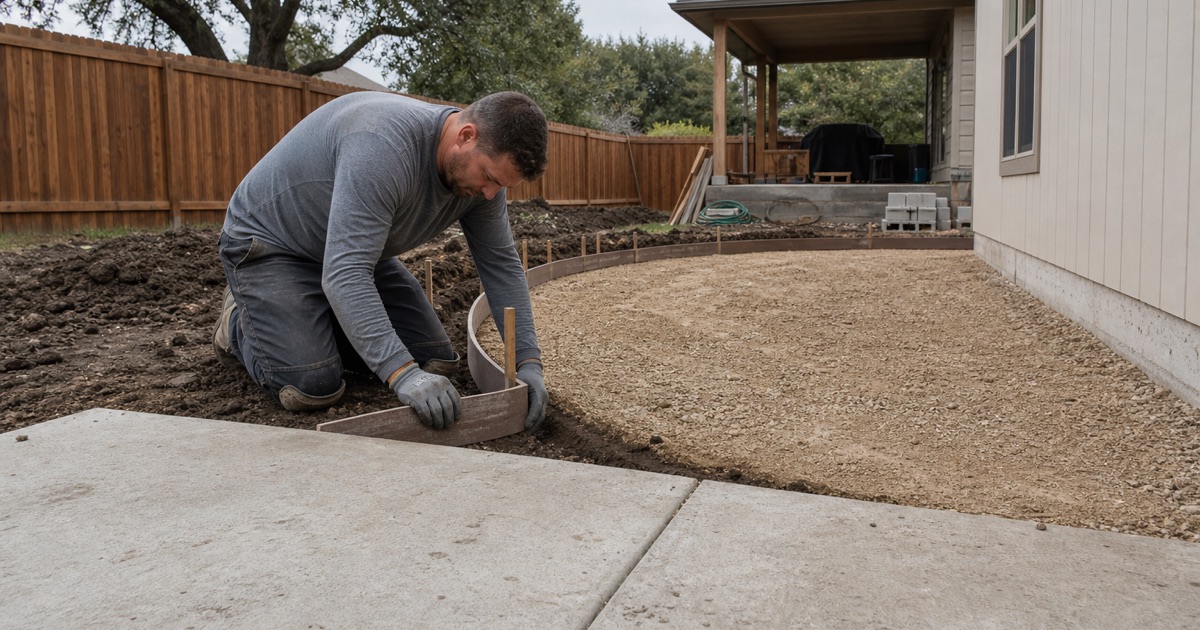
Patio size is usually decided by furniture rather than by area. A dining set with chairs that pull back, a seating group with walking room behind it, and a grill with clearance all have real footprints, and a patio sized without them ends up used as a walkway. Where the slab meets the house matters structurally as well as visually. An isolation joint at the wall lets the patio move independently of the foundation, which is not optional on ground with a plasticity index of 44 that will lift and drop the slab seasonally.
Drainage, Falls and Keeping Water Off the House
Every patio needs fall away from the structure, and getting that wrong is the single most common defect we are called out to fix. A patio poured dead level looks correct on the day and ponds against the wall after the first heavy rain, and the fix is rarely cheap. Where a patio sits below the surrounding grade, or a downspout discharges near it, the drainage design has to be part of the slab rather than something added afterward. Concentrated water at a slab edge is also what washes out the support beneath it.
Joint Layout on Ground That Moves
Concrete on smectitic clay will move, so control joints are placed to decide where it cracks rather than to hope it does not. On a patio the joint pattern is visible, which means it can be laid out as part of the design, following the shape or squaring up to the house. Isolation joints go anywhere the slab meets something that moves differently, including the house wall, a pool shell, a column base or an existing walk. Skipping one is how a patio ends up cracked in its first year through no fault of the concrete.
Concrete Patio Finishes and Colors
Broom, Salt, Float and Exposed Aggregate
A broom finish is the durable default and gives reliable traction wet. A salt finish leaves a fine pitted texture that suits patios well. A float finish is more open and matte, and exposed aggregate reveals the stone in the mix for a textured, stain-tolerant surface that hides use.
The one to avoid outdoors is a hard steel trowel finish. It looks superb indoors and is genuinely dangerous on an outdoor slab once it is wet, which is a straightforward reason we will talk you out of it.
Stamped Patterns and Color for Patios
Stamped patterns turn a patio into the main decorative surface of a yard, and because the base work is identical to a plain slab the premium sits in the finish. Integral color, dry shake hardener, acid stain and dye each age differently outdoors, and exposure decides which is appropriate. Color affects comfort as well as looks. A darker slab absorbs more heat, and on an unshaded patio through a stretch running 101 to 103 degrees that is felt directly through bare feet, so we raise it before a color is chosen rather than after.
Sealing and Realistic Maintenance
A penetrating silane or siloxane sealer resists staining without changing the appearance. A film-forming acrylic deepens the color, adds sheen and needs periodic renewal, and it is the option that makes a stamped or colored patio look its best. Sealing is not the only maintenance item. Keeping the control and expansion joints filled is what stops water reaching the base and washing out support, which is the mechanism behind most of the settled patios we are later asked to lift.
Patio Extensions, Repairs and Additions
Extending or Widening an Existing Patio
Adding to an existing patio always leaves a joint, because new concrete will not knit to cured concrete. We treat that line as a designed feature rather than a defect, detailing it as a proper isolation joint and often using a border or a change of finish so it reads as intentional. Color matching across that line is the harder problem. Weathered concrete has aged and any new pour starts lighter, so where the match matters we look at resurfacing the whole area to one finish instead of trying to blend two.
Repairing a Cracked or Settled Patio
Patios settle for the same reasons driveways do: a void opened by clay withdrawing, poorly compacted fill, or water concentrated at an edge. Where the concrete itself is sound, lifting it back to grade and filling the void underneath costs well under a replacement and takes a fraction of the time. Resurfacing handles the other common case, where the slab is stable but the surface has scaled, spalled or simply worn out. A bonded overlay can carry a new broom finish, a stamped pattern or color, provided the substrate is sound and no longer moving.
Patio Covers, Outdoor Kitchens and Fire Features
Anything that will be built on the patio later changes the slab now. Post bases for a cover, a fire pit surround, or an outdoor kitchen with cabinetry and appliances all need to be located before the pour so the reinforcement, thickness and anchor points are there when they are needed. Retrofitting an anchor into a finished patio is possible and never as good. Telling us what the plan is, even if it is two years out, costs nothing at the design stage and saves cutting into a finished surface later.
- 20+ Years in Central Texas
- Bonded & City Registered
- Free Written Estimates