Temple Elite Concrete handles concrete repair throughout Temple, TX, serving surrounding cities including Belton, Nolanville, Harker Heights, Killeen and McGregor, with 20+ years spent working out why a slab failed before deciding how to fix it. Repair is the corner of this trade where the cheap answer and the right answer sit furthest apart, because nearly every visible defect is a symptom of something under the concrete rather than something in it.
That distinction carries more weight here than in most markets. Around 41% of the mapped soil under the city is deep smectitic clay, where shrink swell potential opens voids beneath a slab through a dry stretch. Another 32% is shallow soil over chalk, where one end of a driveway may rest on rock while the other rests on material that still compresses. The same crack on two streets can have two causes and two different repairs.
So every repair we quote opens with a diagnosis you can read: what moved, why it moved, whether it is still moving, and what each honest option costs. Where the failure sits in the surface layer we say so, and where a slab is genuinely past saving we say that too, with the replacement figure printed beside the repair figure rather than in place of it.
What Concrete Repair Actually Fixes
Settled and Sunken Concrete Slabs
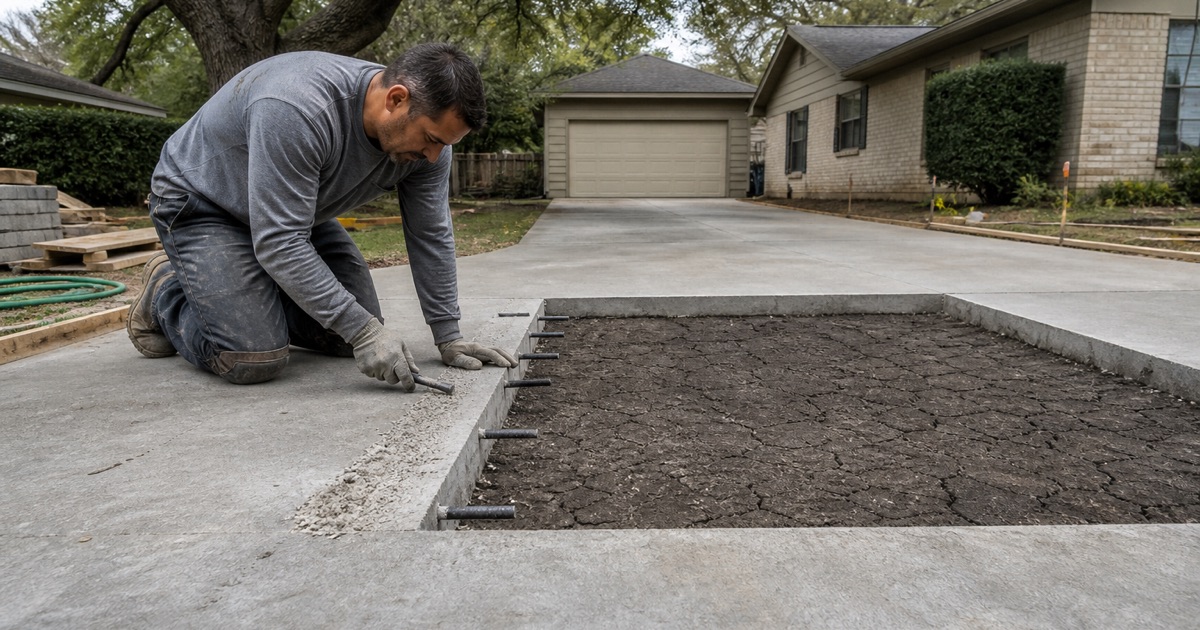
Settlement shows up as one panel sitting lower than its neighbor, a driveway apron dropping away from a garage, or water standing where it used to run off. The concrete itself is usually undamaged; what failed is the support beneath it, either a void left by clay withdrawing during drought or fill that never reached density. Lifting the slab back to grade solves it, provided the space underneath gets filled at the same time.
How far a panel can be brought back depends on what it is still tied to. A driveway locked against a garage slab and a curb has less room to move than a free-standing patio, so we check the adjacent panels and the joints between them before committing to a target elevation. Lifting one panel past what its neighbors can follow simply relocates the lip.
Cracks, Control Joints and Failed Sawcuts
A crack that tracks the sawcut pattern and stays tight is the slab relieving shrinkage stress where it was designed to, and it needs sealing rather than surgery. A crack that wanders diagonally, keeps opening, or leaves a lip between the two sides is structural, and filling it changes nothing about the cause. We map the cracks, note which ones have moved since the last rain, and treat the two categories differently.
Sealing is not cosmetic either. An open control joint lets water and grit down to the base and lets weeds lever it wider, so joints get cleaned and filled with a material chosen for how much movement that joint actually sees. A rigid epoxy filler belongs in an interior slab carrying wheel traffic; an outdoor joint on clay needs something that can stretch.
Spalling, Scaling and Worn Surfaces
Spalling lifts concrete away in flakes and shallow craters, generally where reinforcement sits too close to the surface or the slab was troweled while bleed water was still on top. Scaling peels the finished layer off in sheets. Both are surface-layer failures on concrete that is often structurally fine underneath, which is why a bonded overlay frequently resolves them for a fraction of a tear-out.
Concrete Repair Methods and When Each Applies
Polyurethane Foam Slab Jacking
Foam lifting injects an expanding polymer through small ports drilled in the slab, filling voids and raising the panel by controlled increments. It adds very little weight to ground that already proved it could not carry what was there, sets quickly, and takes traffic the same day. On expansive clay subgrades that low added load is the entire reason to choose it over the heavier alternative.
The ports are small enough to disappear into a broom finish once patched, and the polymer expands into every void it reaches rather than only the one directly under the hole. Where a slab sits on soil that is shallow over rock, that spreading behavior is useful, because the soft material is often a thin layer over an unmoving surface.
Mudjacking and Slurry Slab Lifting
Mudjacking pumps a cement and soil slurry through larger holes to raise the same slab. It costs less per lift and the material is inexpensive, but it puts substantial additional weight onto the failed subgrade and the holes are noticeably bigger. It earns its place on thick, heavily loaded slabs over stable material, and we will tell you when your driveway is not that.
Grinding and Partial Panel Replacement
Where one panel has heaved a lip above its neighbor, a walk-behind grinder can take the offset down to a walkable transition in a single visit without touching the rest of the run. Where a panel is broken beyond that, cutting and replacing only that panel keeps the surrounding concrete, its joints and its finish intact. Both are small invoices, which is precisely why they get skipped elsewhere.
Resurfacing and Bonded Overlays
A polymer-modified overlay bonds a new wearing surface over concrete that is sound but ugly, and it can carry a broom finish, a stamped pattern or integral color while it does. It is the right tool for scaling, minor spalling and general wear, and the wrong tool for a slab still moving, because an active crack reads straight through an overlay within a season.
Residential and Commercial Concrete Repair
Driveway, Patio and Walkway Repair for Homeowners
Residential repair is usually about a driveway apron that has dropped, a patio that now drains toward the house, or a front walk with a lip somebody has already tripped on. These jobs are decided by cost against remaining life, so we quote them that way: what a lift or a grind buys, what a replacement buys, and how much longer the untouched concrete around it realistically has.
Commercial Flatwork, Parking Lot and Dock Repair
Commercial repair adds liability and access to the equation. A sunken panel in an accessible route, a broken dumpster pad, or a dock apron spalling under wheel loads all have to be fixed without closing the site any longer than necessary. We phase the work, keep the accessible route usable, and match repairs to the perimeter curb and gutter and island detailing already on the property.
Accessible routes carry their own trap. Replacing a panel at a curb ramp means the ramp, its landing, the side flares and the detectable warning surface all have to come back working together, and a repair that fixes the concrete while leaving one of those wrong turns a maintenance item into a rebuild. We treat the whole route as the unit of work.
Our Step-by-Step Concrete Repair Process
Step 1: Diagnose the Failure, Not the Symptom
We probe the affected panels, look at drainage, check elevations across the run, and establish whether we are dealing with a void, a compressible base, tree roots, or concrete that simply wore out. Nothing gets priced before that, because the same visible crack over a void and over solid ground call for entirely different work. On a lot where the excavation may run into rock we also establish the likely depth to refusal early, since paralithic bedrock sits at a representative 20 centimeters under Eddy soils and 74 centimeters under Austin. A repair that turns into rock excavation halfway through is a quote that doubles, and there is no reason for that to be a surprise.
Step 2: Written Options, Both Numbers Shown
You get a written proposal listing each viable method with its cost, alongside what full replacement of the same area would run. Where more than one method would work we say which we would pick and why. Where a repair only buys a couple of seasons because the surrounding slab is failing too, that is stated rather than left for you to discover.
Step 3: Permits Where the Work Touches Right-of-Way
Repairs that stop at the property line need no city involvement. Repairs that touch a drive approach, curb, gutter or public sidewalk do, and we pull the permit, post it, and schedule around the city’s review window rather than starting and hoping. Sidewalk work also has to go back without narrowing or regrading the walk.
Step 4: Repair, Seal and Verify
After lifting or replacement we seal the ports and joints, restore the joint pattern so the slab keeps relieving stress where it should, and re-check elevations across the whole run rather than only the panel we touched. Washout and slurry from cutting or grinding are contained on site, since discharging either to the storm sewer is an offense under the city’s stormwater chapter.
- 20+ Years in Central Texas
- Bonded & City Registered
- Free Written Estimates