Temple Elite Concrete provides concrete resurfacing in Temple, TX, serving surrounding cities including Belton, Nolanville, Harker Heights, Killeen and McGregor, and after 20+ years the honest summary of this service is that it is either the best value on our price list or entirely the wrong answer, with very little ground in between. Resurfacing bonds a thin new wearing layer onto concrete that is already there. When the slab underneath is structurally sound and only the top has worn out, it delivers a new surface, a new texture and a new color for a fraction of demolition and replacement, with no dump trucks and no week of curing before the area is usable.
When the slab underneath is still moving, it delivers all of that for about a year, and then the crack comes back through. So the assessment matters more than the product, and we spend the first visit on the substrate rather than on the sample board.
When Concrete Resurfacing Is the Right Call
Reading the Substrate Before Anything Else
We sound the slab for hollow areas, check elevations across the run for settlement, look at the crack pattern to see whether it follows the sawcuts or ignores them, and test whether the existing surface is sound enough to bond to. Those four readings decide the recommendation.
A slab that has settled can often be lifted first and resurfaced afterward, which is a two-stage job rather than an impossible one. A slab cracked through in several directions on ground that is still working is not a resurfacing candidate at any price. Saying that at the assessment costs us a job and saves you paying twice for the same square footage.
Surface Failures an Overlay Genuinely Fixes
Scaling, where the finished layer peels away in sheets, and light spalling, where concrete flakes off in patches, are both failures of the top layer on concrete that is frequently fine underneath. So is general wear: a driveway that has simply gone rough and dusty after decades of sun. Discoloration, patch marks from earlier repairs, and a finish that was troweled or broomed badly the first time are cosmetic problems an overlay solves completely, because the new surface is what you see rather than a treatment applied over the old one.
What Resurfacing Cannot Do
An overlay adds a thin layer, not structure. It will not carry loads the slab underneath cannot, it will not bridge a void, and it will not stop a crack that is still moving, because an active crack telegraphs straight through any bonded layer within a season. Height is the other limit. A new layer raises the surface, which matters at thresholds, door swings, garage seals and where the slab meets a walk or a step, so we check those clearances before proposing a system rather than discovering them mid-job.
Overlay Systems and Surface Preparation
Microtoppings, Skim Coats and Spray Texture
A microtopping or skim coat is the thinnest option, restoring a smooth or lightly textured surface and taking color well. A spray texture, applied through a hopper gun and knocked down, produces a slip-resistant finish that suits pool decks and walkways and hides minor unevenness better than a smooth coat.
Stamped and Patterned Overlays
A stamped overlay is thick enough to take a mat impression, so an existing patio or driveway can be given a stone, slate or brick pattern with integral color and a contrasting release agent, exactly as a fresh stamped pour would be. It is the option that changes a surface most dramatically. Border patterns and sawcut detail can be worked in at the same time, so the layout is redesigned rather than merely refinished.
Because the pattern is pressed into a bonded layer rather than a full-depth slab, joint layout matters even more than usual. Existing control joints have to be honored through the overlay or they will reappear as random cracks in the new surface.
Surface Preparation and Bond
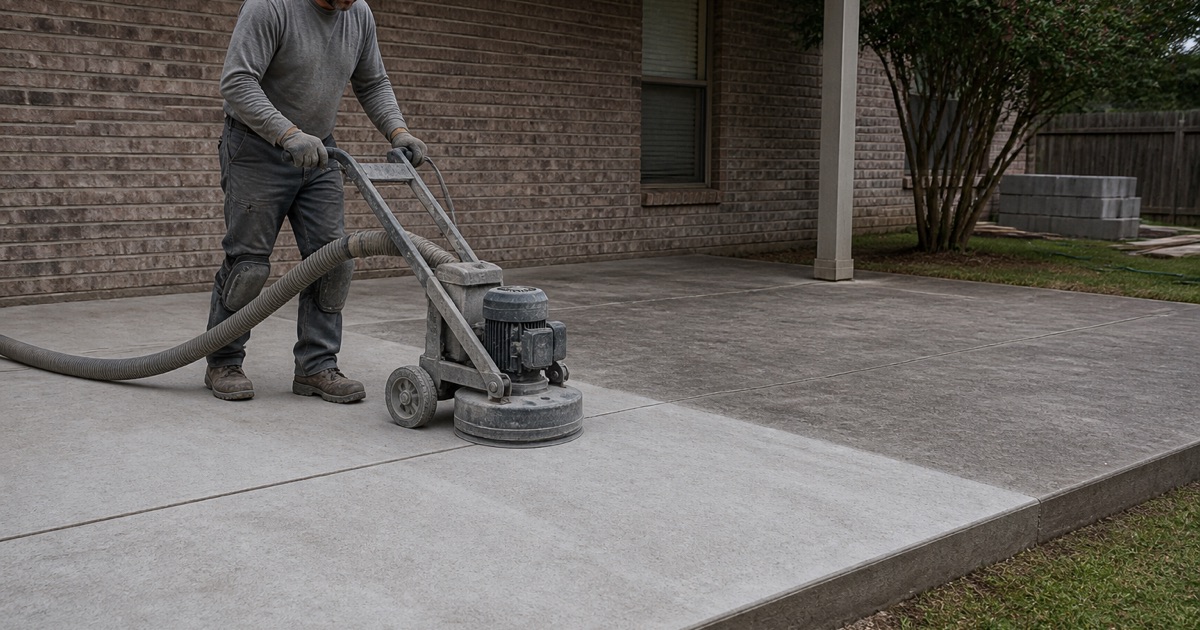
Preparation is the part that decides whether an overlay lasts. The existing surface is mechanically profiled by grinding or shot blasting to open it, contaminants and old coatings are removed, and a bonding agent or primer is applied to the system manufacturer’s specification. Dust and slurry from that work are contained on site, since a harmful quantity of dust from sanding, grinding, cutting or sawing is an offense under the city’s stormwater chapter alongside washout, and grinding a whole driveway generates a great deal of both.
Cost, Longevity and Where Resurfacing Fits
Resurfacing Against Full Replacement
Resurfacing avoids demolition, disposal, forming, reinforcement, a full-depth concrete order and a long cure, so on a sound slab it lands well under replacement and the area comes back into use far sooner. That gap is what makes it worth assessing honestly rather than selling automatically. Replacement wins where the concrete is failing rather than the surface, where the slab is unsupported, or where the required thickness was never there. Paying for an overlay in those cases buys a delay rather than a repair, and we say so before the work is booked.
How Long a Resurfaced Slab Lasts
An overlay on a stable, well-prepared substrate wears like the concrete beneath it and is maintained the same way. Its life is governed by the slab under it, not by the coating, which is why the substrate assessment is the whole job in miniature. Sealing extends it. A penetrating sealer resists moisture and staining without changing the look, while a film-forming sealer deepens a colored overlay and needs periodic renewal, and joints kept filled stop water getting beneath the slab and undoing everything above it.
Interior, Commercial and Pool Deck Applications
Interior slabs, shop floors and retail areas are strong candidates because the disruption of replacement is the real cost, and an overlay can often be staged section by section while a space stays in use. Pool decks are the other natural fit, where a textured overlay restores slip resistance and appearance on a slab that is structurally fine. A grit additive in the sealer raises traction further on a surface that spends its life wet.
Color is worth thinking about on a deck as well as texture. A lighter overlay absorbs less heat than the weathered gray slab underneath it, which is a genuine comfort difference on an unshaded deck through a run of days at 101 to 103 degrees.
- 20+ Years in Central Texas
- Bonded & City Registered
- Free Written Estimates