Temple Elite Concrete works as a concrete contractor at Fort Hood, TX, with 20+ years of pavement, flatwork and slab work behind us. The technical detail that matters most here is one that most concrete crews have backwards, because the standard practice governing concrete pavement on the installation reverses the usual moisture rule for compacting subgrade, and the built area sits on exactly the soil it reverses it for.
Ordinary practice on a fine-grained subgrade is to compact slightly dry of optimum moisture. That produces good density and a firm platform, and on most soils it is right. On an expansive clay it is the wrong direction entirely, because a subgrade compacted dry will take water afterward and swell against the slab it is supporting.
UFC 3-250-04, Standard Practice for Concrete Pavement Construction, dated 29 January 2024, says so explicitly at paragraph 4-2.2.2: expansive subgrade is to be brought to a moisture content 1 to 3 percent above optimum before compaction in order to reduce swell potential, against 1 to 2 percent below optimum for non-swelling fine-grained soils. Two soils, two opposite instructions, and the difference between them is the difference between a pavement that lasts and one that heaves.
What Is Under the Built Area
The San Saba-Urban Land Complex
The developed cantonment is mapped as the San Saba-Urban land complex on 0 to 3 percent slopes, which is 54 percent San Saba and 25 percent urban land. San Saba is classified as a Fine, smectitic, thermic Leptic Udic Haplusterts, which is to say a Vertisol: a clay that shrinks and swells with moisture rather than one that simply carries load.
That places expansive clay directly beneath the developed footprint rather than out at the edges of it. This is not a case where the difficult soil is somewhere else on the installation and the built area sits on something benign. The buildings, the pavement and the flatwork are on it.
That is also why the mapped complex is worth naming rather than describing loosely. Urban land makes up a quarter of the unit, which means a share of the footprint is already disturbed and reworked material rather than an intact profile, and disturbed ground is exactly where a single assumption about what lies beneath tends to fail.
Thirty-Six Inches of Clay, Then Rock
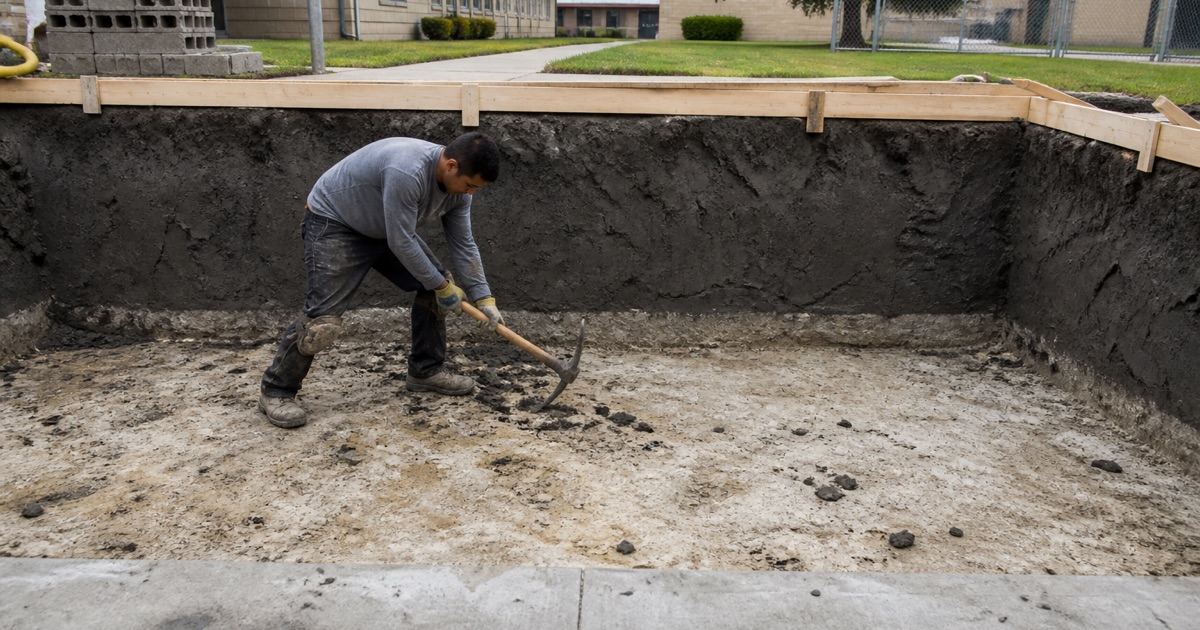
The profile is specific and it is worth knowing before anyone quotes an excavation. San Saba in that complex runs a plasticity index of 38 with 52.5 percent clay from the surface down to 91 centimeters, about 36 inches, where it terminates on indurated lithic bedrock. Off the built area, on the San Saba clay unit, the same rock sits at 76 centimeters, about 30 inches.
So the working section is roughly three feet of highly reactive clay sitting on hard rock. That combination is its own design problem: there is enough reactive material above the rock to move a slab appreciably, and no deeper stable layer to reach without breaking stone.
It also limits the usual remedies. Undercutting and replacing a reactive layer is a familiar approach elsewhere, but with rock at about three feet there is not much room between the bottom of the reactive material and the top of the stone, so conditioning the clay in place carries more of the load than it would on a deep profile.
Where Depth to Rock Changes Over a Few Hundred Feet
The other half of the picture is that the depth is not consistent across the installation. Purves silty clay and the Eckrant-Purves association both reach lithic bedrock at 36 centimeters, about 14 inches, with Purves indurated and Eckrant strongly coherent, while Brackett loam reaches weakly coherent paralithic bedrock at 41 centimeters, about 16 inches.
The practical consequence is a footing trench that cuts freely on one site and meets limestone a few hundred feet away. We establish the likely depth to refusal for the specific area of work rather than carrying an assumption across a job, because the difference between digging and breaking rock is the single largest swing in an excavation price.
Looking for concrete-contractor closer to Jarrell? See Concrete-Contractor in Jarrell.
The Compaction Rule That Runs the Other Way
Why Ordinary Practice Is Wrong for This Clay
Compacting a clay dry of optimum gets you a dense, firm subgrade on the day. The problem arrives later. A clay compacted below its optimum moisture has capacity to absorb water, and an expansive clay that absorbs water expands, so the platform that was firm at placement becomes a platform that pushes upward on the pavement above it.
Conditioning the subgrade wet of optimum instead accepts slightly lower density in exchange for a subgrade that is already near the moisture it will settle at. It has less swell left in it, which is the entire point of the specification.
The trade is deliberate rather than accidental. Density is not the objective in itself on an expansive subgrade; a stable moisture state is, because the failure mode being designed against is not settlement under load but uplift as water arrives. Reading the specification that way makes the direction of the rule obvious rather than counterintuitive.
One to Three Percent Above Optimum
The specification puts numbers on it rather than leaving it to judgment. Expansive subgrade is brought to 1 to 3 percent above optimum before compaction. Non-swelling fine-grained soils go the other way, to 1 to 2 percent below optimum. Both figures come from the same paragraph of the same document, which is what makes the contrast so useful: the standard is not silent on ordinary soils, it deliberately treats expansive ones differently.
Knowing which of those two applies is therefore a soil identification question before it is a compaction question, and getting it wrong does not produce a marginally worse result. It produces the opposite of what was intended.
What That Looks Like on Site
In practice, conditioning to above optimum means moisture is added deliberately and worked through the layer rather than sprayed on the surface, then given time to distribute before compaction. It means testing rather than judging by appearance, since clay at the right moisture and clay slightly too wet look similar and behave very differently under a roller.
It also affects sequencing. A subgrade conditioned properly and then left open through a dry stretch does not stay conditioned, so the schedule has to run the conditioning close to the placement rather than treating it as an early item to be ticked off and revisited two weeks later.
Knowing Which Soil You Are Actually On
The Plasticity Index Test That Has to Be Cleared First
The trigger for all of this is a measurement. IBC section 1803.5.3 treats a plasticity index of 15 or greater, determined in accordance with ASTM D4318, as the first of four provisions defining an expansive soil. That is the threshold the conditioning requirement is aimed at.
Against it, almost everything mapped in the developed area clears comfortably: San Saba at 38 to 40, Purves at 33 to 39, Eckrant at 37, Crawford at 33 to 37, Denton at 35 to 37 and Krum at 32 to 35. These are not marginal readings, which is why the reversed compaction rule is the normal case here rather than the exception.
Brackett Loam, the Local Exception
There is one common soil that does not clear the threshold. Brackett loam runs a plasticity index of 11 in its A horizon and 13 in the Bk, with only 21 to 25 percent clay, so it sits below the plasticity index of 15 that every other major soil mapped here exceeds.
That matters because it means the expansive treatment is not universally correct on this ground either. Conditioning a non-swelling soil to above optimum is applying the wrong half of the same specification, and the honest position is that the soil has to be identified rather than assumed in either direction.
Why One Detail Does Not Cover the Installation
Between roughly three feet of highly reactive clay over rock in the cantonment, rock within about fourteen inches on the Purves and Eckrant-Purves units, and a genuinely non-expansive loam over paralithic rock at about sixteen inches, a single standard detail cannot be right everywhere.
We treat the soil identification as the first deliverable rather than a formality, because it determines the excavation method, the conditioning direction, the subgrade preparation and the section above it. Every downstream decision on the job depends on which of those three pictures is actually under the work.
Placing, Finishing and Working on Federal Ground
Placing and Finishing on Conditioned Subgrade
A subgrade conditioned above optimum is a different surface to work on than a dry one, and the crew has to be ready for that. It is softer under traffic, it needs protecting from the plant moving across it, and it should not be allowed to dry out between conditioning and placement.
Handled properly none of that is difficult. Handled as an afterthought it produces the classic outcome where a specification was met on paper at the compaction stage and quietly undone by the two weeks that followed, which is a failure nobody can see until the pavement starts moving.
Federal Contracting and Prevailing Wage
Work here is federal contracting rather than a homeowner sale, and that carries its own requirements. FAR 52.204-7 requires an offeror to hold an active SAM.gov registration when submitting an offer and at the time of award, with FAR 52.204-13 requiring it to be maintained through final payment.
Prevailing wage applies as well. FAR 22.403-1 puts the Davis-Bacon Act into contracts in excess of $2,000 for the construction, alteration or repair of public buildings or public works, through the FAR 52.222-6 clause. Both are worth confirming a bidder actually satisfies, because neither is something that can be resolved after an award.
The Installation’s Name, and Why It Still Matters on Paper
Naming is a live hazard in written work here, and it is worth getting right. The installation is Fort Hood: it was officially renamed Fort Cavazos on 9 May 2023 and redesignated Fort Hood effective 11 June 2025. The prior name is still current in a great deal of third-party and federal data, so both names turn up in records, mapping and databases that have not caught up.
That is a document-handling issue rather than a trivia point. A submittal, a drawing set or an address record carrying the wrong name against a system expecting the other one is a small administrative delay that lands at exactly the moment nobody has time for it, so we check what each recipient expects rather than assuming consistency.
- 20+ Years in Central Texas
- Bonded & City Registered
- Free Written Estimates