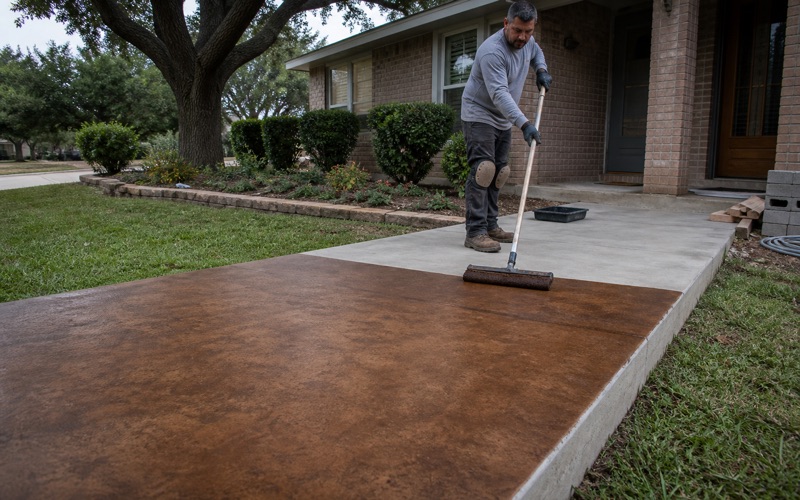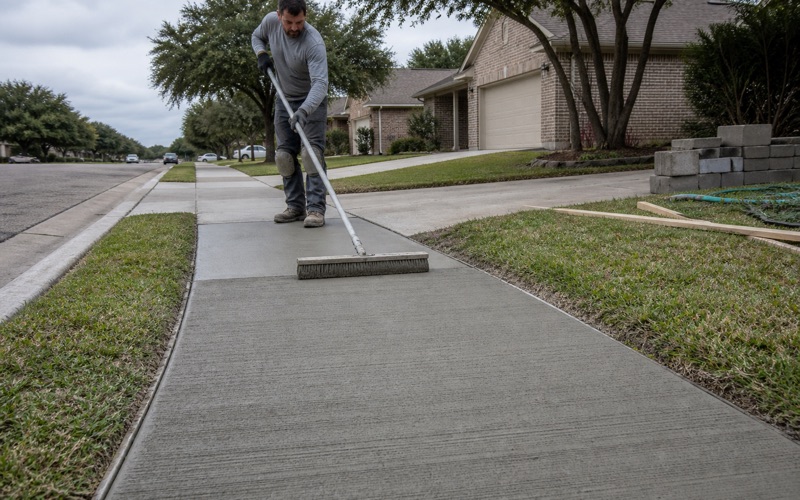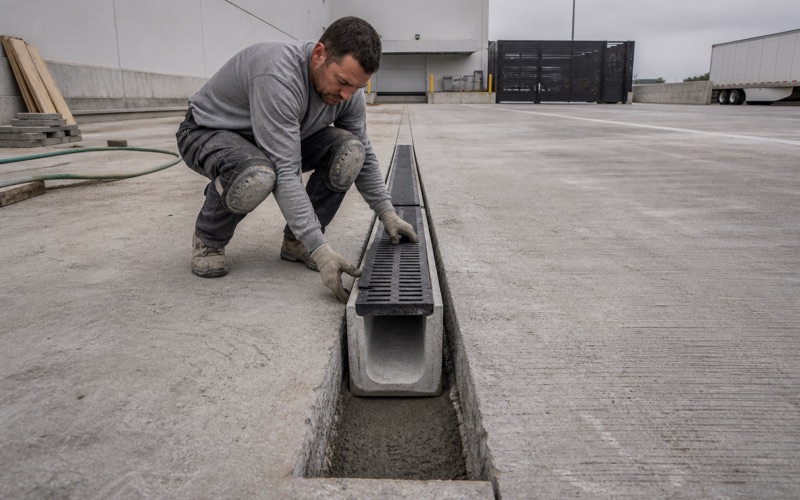
Temple Elite Concrete works as a concrete driveway contractor in Killeen, TX, with 20+ years of tear-outs, repours, approaches and flatwork behind us. Most of the driveway work in this city right now is replacement rather than new construction, and that is not an impression. It is what the housing numbers say, and it changes what a driveway job here actually consists of.
The largest single cohort of houses in this city went up through the 2000s, and every one of them came with a driveway, a walk and usually a patio. That concrete is now roughly seventeen to twenty-two years old, which is precisely the age at which flatwork on reactive clay stops being something you sweep and starts being something you decide about.
Meanwhile the builder pipeline behind it has thinned considerably, and the gap between what was being poured then and what is poured now is wide enough to change what this trade consists of here. The concrete work available today is weighted heavily toward slabs that already exist, which is a different job from pouring for a builder, and it is the one we are set up for.
The Decade That Poured Most of Killeen’s Driveways
The 2000s Cohort, and Where It Sits Now
That cohort is 14,001 units, 21.3 percent of the stock, built between 2000 and 2009. A driveway poured in 2005 has been through twenty summers of wet and dry cycling on soil that changes volume with moisture, and it was built to whatever the standard detail of the day was on that subdivision. Some of those slabs are in good order and will take a repair. Others have reached the point where the crack pattern, the joint condition and the settlement between panels are all telling the same story.
Age alone does not decide it, which is why we look rather than assume. What age does tell us is which questions to ask first: how thick the original section was, whether it was reinforced, and whether the subgrade under it was prepared or simply graded flat before the pour.
Those three answers usually explain everything visible on the surface. A thin unreinforced section over an unprepared subgrade will have started cracking early and kept going, while a properly detailed slab of the same age tends to show wear and open joints rather than structural failure. Reading which one is in front of us is what the first visit is for.
What the Permit Series Says About the Market
The trend in the permit numbers is worth understanding as a homeowner, not only as a contractor. Single-family permits ran between 1,155 and 1,286 a year from 2004 through 2007, then fell from that 1,286 peak in 2006 to 700 in 2019, 517 in 2022, 499 in 2023, 650 in 2024 and 493 in 2025, with 357 issued through July of 2026. A market with less builder work and a large aging cohort is a replacement market.
That has a practical consequence for anyone hiring. The crews still working here are working on existing slabs, and the skills that matter are demolition, subgrade correction and matching into what stays, rather than the volume production that suited a subdivision under construction.
Detached Houses, and Who Signs
Of 65,000-odd housing units in the city, 40,272, or 61.2 percent, are single-family detached, so this is overwhelmingly a city of houses with their own driveways. A quarter of the occupied ones are rentals: 10,115 of 38,300 occupied detached houses are renter-occupied rather than owner-occupied.
That matters procedurally more than most contractors admit. On a large share of driveway work here the person who calls, meets us on site and describes the problem is not the person who will approve the expenditure or sign the contract. We establish who the decision-maker is early and keep the tenant informed rather than bypassed, because a job that has to be re-approved after the quote is a job that stalls.
Looking for concrete-contractor closer to McGregor? See Concrete-Contractor Services in McGregor.
A Twenty-Year-Old Driveway on Killeen Ground
How a Slab From That Era Typically Fails
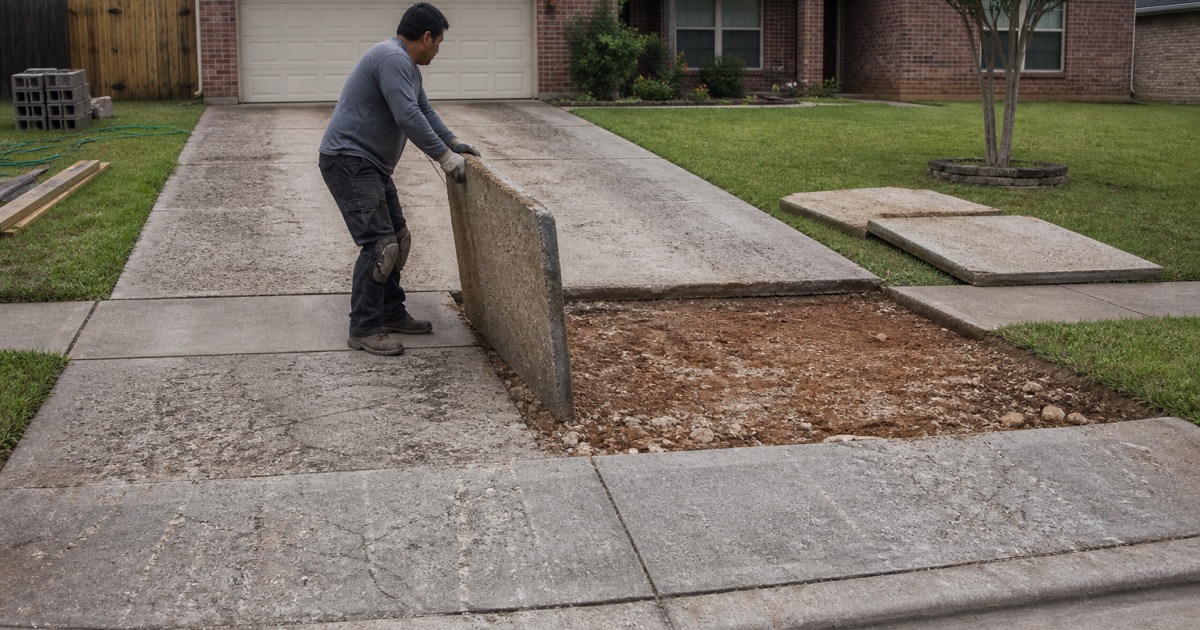
The common pattern is not sudden. Joints open and stop being sealed, water gets to the base, the subgrade under one part of the slab moves differently from the rest, and a panel starts sitting proud or low against its neighbor. Surface breakdown follows in the wheel paths and around the apron where the loading is heaviest.
The second pattern is cracking that ignores the sawcuts entirely, running diagonally across panels. That is the slab telling you about differential support underneath rather than about shrinkage, and it does not respond to surface treatment.
The apron is where both patterns show up first, because it takes every vehicle at an angle and sits where the drive meets ground the builder disturbed most. A driveway that is sound for most of its length and broken at the street end is a common and genuinely repairable case, and it is worth quoting as a partial rather than as a whole.
Repair, Resurface or Replace
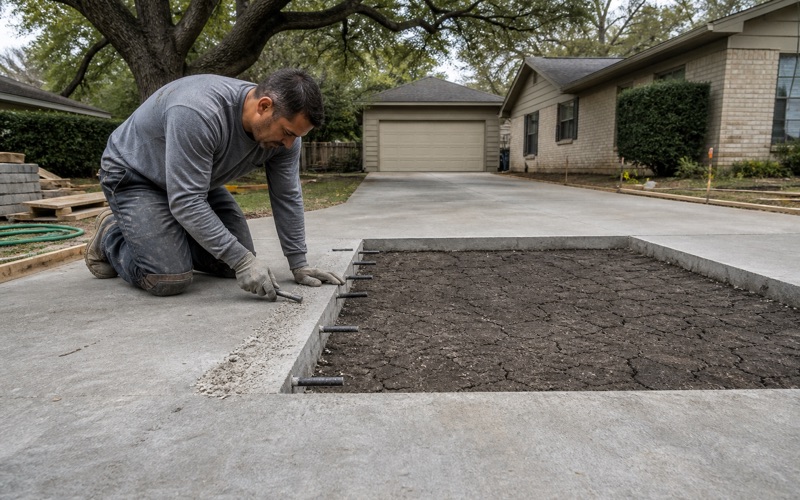
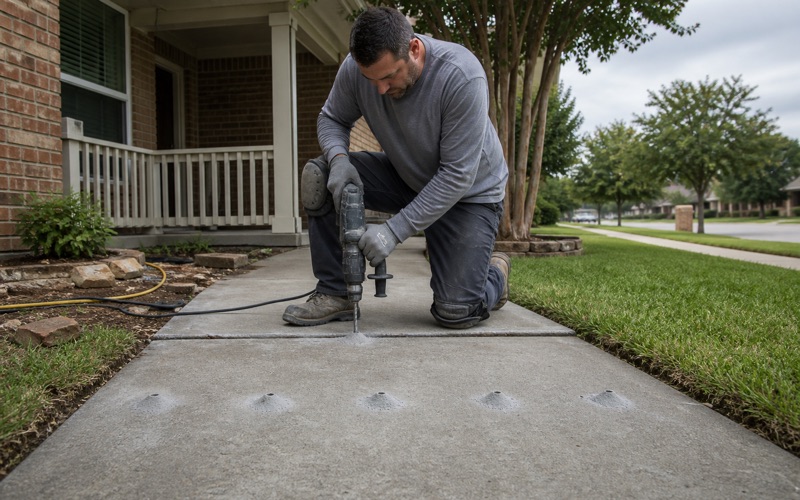
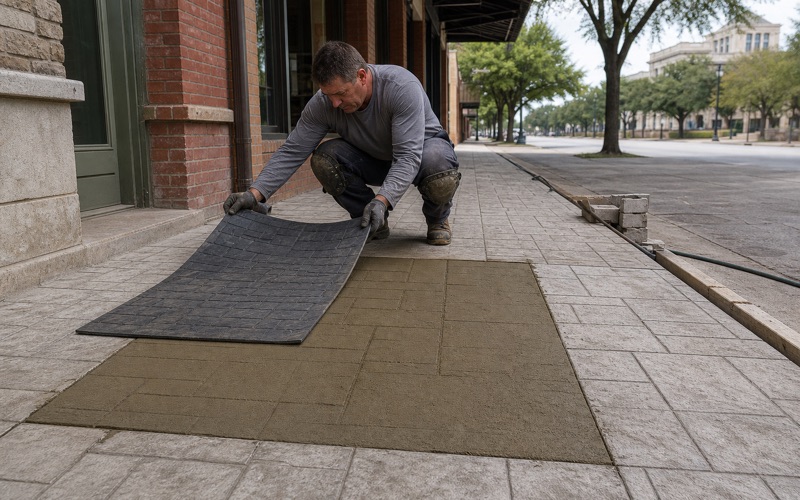
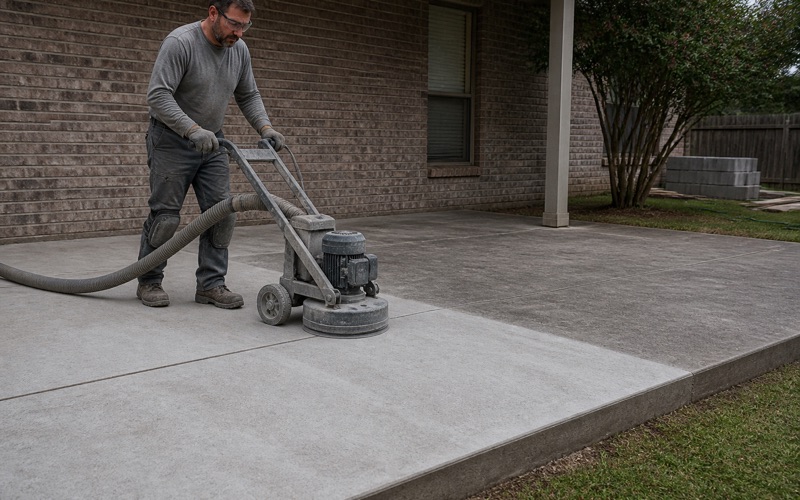
Repair holds where the concrete is sound and the problem is a void, a lifted panel or a failed joint. Resurfacing holds where the structure is fine and the surface has scaled or worn. Replacement is the answer once panels are cracked through in several directions, the original section was too thin for what uses it now, or the base has to be rebuilt regardless.
We quote the options against each other with real figures rather than steering to the largest one, because leveling or partially replacing an existing driveway usually lands well under a full tear-out, and on a slab with years left in it that is the honest recommendation.
What the Subgrade Does to the Decision
The ground under a Killeen driveway is expansive by the code’s own test on most of the city, with surface plasticity index running around 39 for Purves and 37 for Denton against the plasticity index of 15 that IRC section R403.1.8.1 uses as its first criterion. That is what drives the seasonal movement behind most of the settlement and cracking we are called to look at.
It also varies within a single subdivision, which is why a neighbor’s experience is a poor guide to your own quote. Two houses on one street can sit on materially different material, and the repair that worked three doors down may not be the right one here.
That variation is why we look at the specific lot rather than the subdivision. Sampled across the city the readings genuinely differ, from deep clays with no restrictive layer to associations sitting on rock within a foot of the surface, and the difference decides both the repair method and the excavation price.
Tear-Out and Repour Where Rock Sits High
Rock At or Just Below Slab Depth
A replacement is only a straightforward demolition if what is underneath behaves. Across much of this city it does not: Purves reaches lithic limestone at a representative 36 centimeters, about 14 inches, and Eckrant at 23 centimeters, about 9 inches. Those are depths that sit at or just below where a driveway subgrade needs to be.
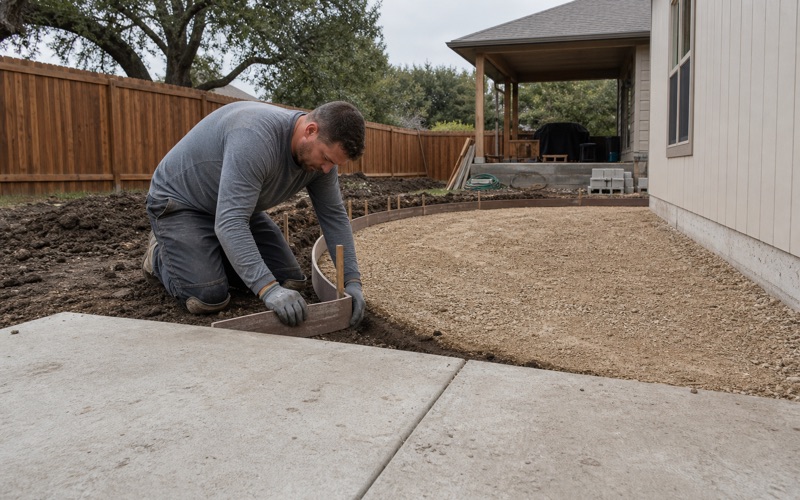
The consequence is that excavation can turn into rock excavation on a job priced as ordinary digging. We establish the likely depth to refusal before quoting rather than after the machine stops moving, because that is the single most common reason a driveway number changes halfway through, and it is entirely foreseeable.
Subgrade Preparation to the City Specification
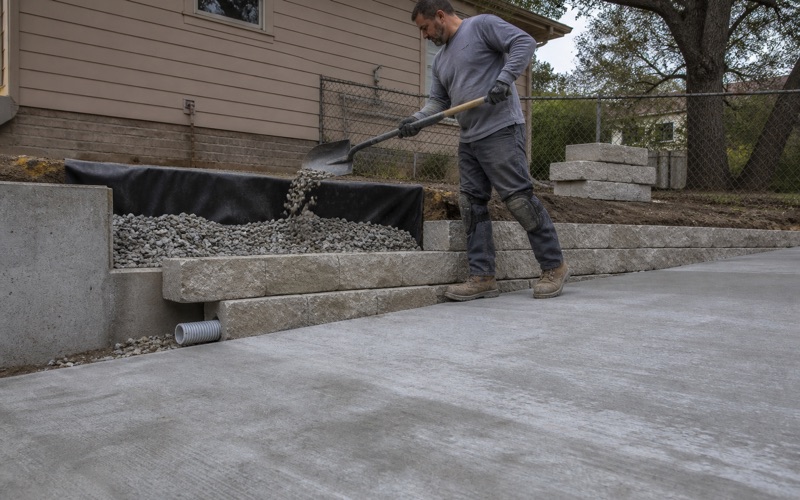
Killeen puts its subgrade requirements in writing. The Infrastructure Design and Development Standards Manual, at Item 805, requires the subgrade to be excavated and shaped, hand tamped, sprinkled where the city considers it necessary, and moist at the time the concrete is placed. Expansion material is required wherever a sidewalk or driveway abuts a curb or a retaining wall, and around every blockout and obstruction.
The moisture requirement is the part worth dwelling on, because it is easy to skip and it matters on this soil. A dry subgrade pulls water out of the bottom of a fresh slab, and on ground that already moves with moisture the last thing a new driveway needs is to start life drying from underneath.
Reinforcement, Jointing and the New Section
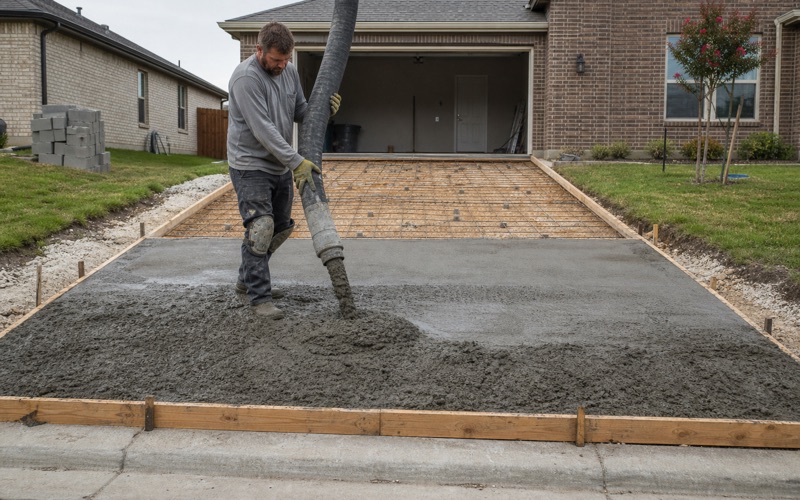
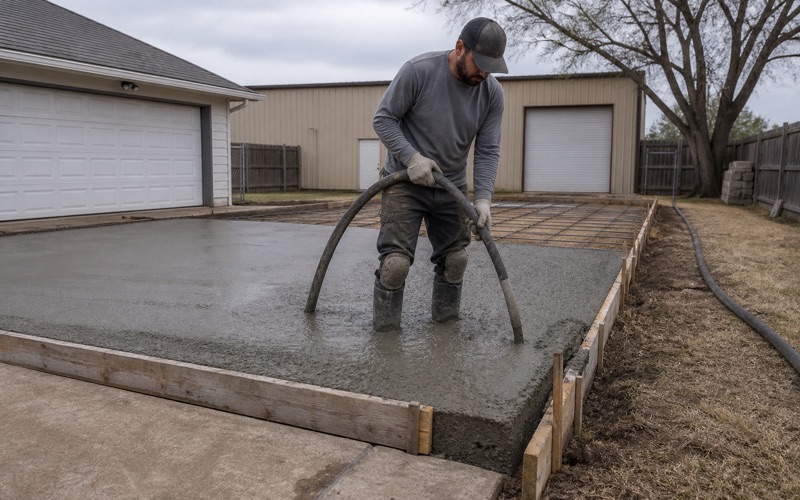
A replacement is the one chance to fix what the original detail got wrong. Thickness gets sized to what actually uses the drive, reinforcement to the loads and the soil movement, and control joint spacing to direct the cracking rather than leave it to chance. Isolation joints keep the new slab from binding against the garage and the approach.
Where the drive ties into a walk, an apron or a curb, those transitions are detailed as joints rather than as continuous concrete, since two slabs on different subgrades moving as one is how a new crack appears in the first season.
Permitting and Pricing a Driveway Replacement
Flatwork Permits by Area
Killeen permits flatwork by area rather than by a flat fee: $0.11 per square foot with a $70 minimum, plus a $10 technology and application fee. That means the permit cost scales with the job and is calculable in advance, so it appears as a real line on our proposal rather than as an allowance.
Inspection has its own arithmetic. A failed inspection of any kind costs $50 and a partial inspection $35, which is a modest sum individually and a good argument for getting the subgrade and the forming right before calling for one.
Contractor Registration and Insurance
The city requires its own construction registration before a contractor may perform, contract to perform, or even obtain a permit for permit-requiring work, at $80 per year. Any contractor type not separately listed falls into the general contractor category, which carries a minimum comprehensive general liability policy of $100,000 per occurrence.
Both are worth asking any bidder about, because they are checkable and they are the closest thing to a credential in a trade the state does not license. Ours are current.
What We Quote, and What Changes It
Our proposal sets out the demolition and disposal, the excavation with an honest read on rock, the subgrade preparation, the section and reinforcement, the jointing, the permit by area and the inspection allowance, as separate lines. What moves the number afterward is almost always what is found under the old slab.
So we would rather find it first. That is why the assessment comes before the price, why the depth to refusal question gets asked on the driveway rather than in the office, and why on a rental property we make sure the owner has the same document the tenant does.
- 20+ Years in Central Texas
- Bonded & City Registered
- Free Written Estimates