
Temple Elite Concrete builds concrete retaining walls in Temple, TX, serving surrounding cities including Belton, Nolanville, Harker Heights, Killeen and McGregor, and 20+ years here has made one point unavoidable: a retaining wall is holding back soil and water together, and the water is what fails it. A wall is a structure with a permanent load on one side of it. Soil pushes laterally, that push grows with height, and it grows again when the soil behind the wall is saturated. On smectitic clay the push is not even constant, because the material behind the wall swells as it takes on moisture and presses harder than a drained granular backfill ever would.
That is why the parts of our walls you can see are the least interesting parts. The footing, the bearing material under it, the drainage layer behind it and the reinforcement inside it determine whether the wall is still straight in ten years, and none of them are visible once the job is finished.
Retaining Wall Types and How They Work
Poured Concrete Gravity and Cantilever Walls
A gravity wall resists soil pressure with its own mass and works well at modest heights. A cantilever wall uses a reinforced stem tied into a footing, so the weight of the retained soil sitting on the heel of that footing helps hold the wall in place, which is what lets it go taller without becoming absurdly thick. Poured concrete gives a monolithic wall with no joints for water to find, and it can be formed to a curve, stepped along a slope, or finished with a texture. It is the option we reach for where the wall is genuinely structural rather than decorative.
Segmental Block and Concrete Masonry Walls
Segmental retaining wall block is dry-stacked and relies on setback, mass and often geogrid reinforcement into the retained soil. It handles curves and steps easily and is quick to build. Concrete masonry units grouted and reinforced produce a rigid wall closer in behavior to poured concrete. Each has its place, and the deciding factors are usually height, the space available behind the wall for reinforcement, and whether the finished face needs to match something already on the property.
Where a Wall Is Structural and Where It Is Landscaping
A low edging wall holding a raised bed is a landscaping element. A wall retaining a change in grade, supporting a driveway, or holding soil above anything a person uses is a structure, and treating the second like the first is the most expensive mistake available in this category. The transition is not obvious from the outside, which is why we assess the retained height, the slope above the wall, and any surcharge load such as a drive or parking area before proposing anything.
Building a Retaining Wall on Expansive Clay
Footings, Bearing and Depth to Refusal
The footing has to bear on material that will hold it, and around here that is two very different problems. On deep smectitic clay with a plasticity index of 44 the footing has to be detailed for soil that changes volume seasonally. On the chalk side of the city, paralithic bedrock at a representative 20 centimeters under Eddy soils means the excavation becomes rock excavation almost immediately. We establish the likely depth to refusal before quoting, because on a rock lot the footing trench is the job and pricing it as ordinary digging is how a number doubles halfway through.
Drainage Behind the Wall
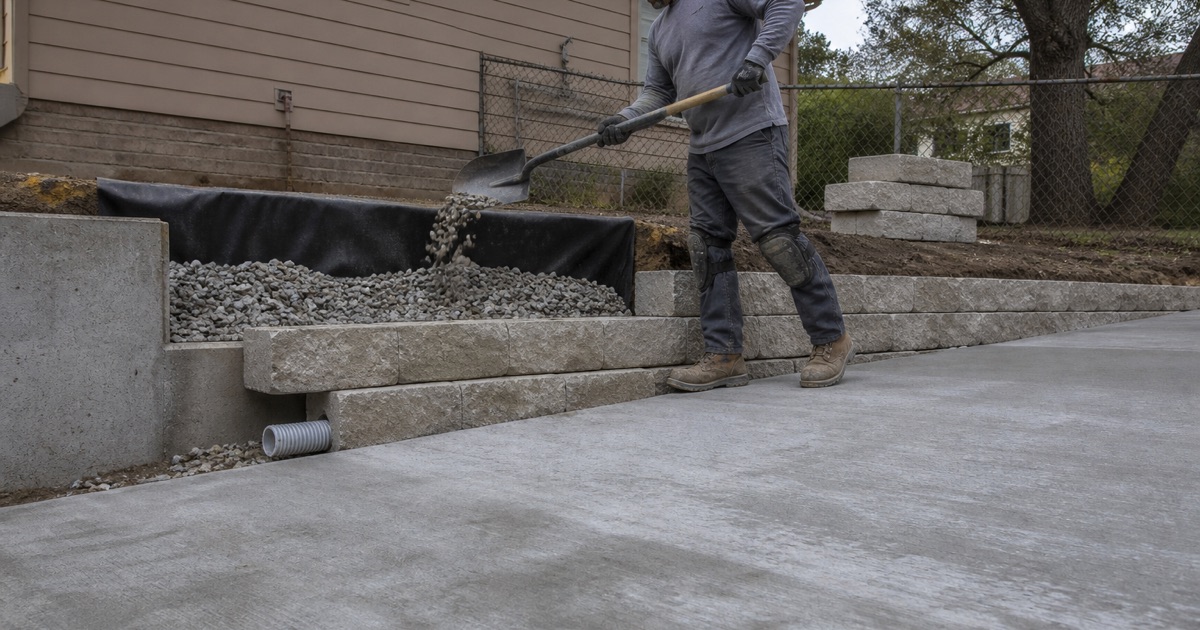
Every wall we build gets a drainage system behind it: free-draining backfill, a filter to stop fines migrating into it, and a drain line with somewhere to discharge. Without that, the wall is holding back saturated soil, and saturated clay pushes far harder than the wall was ever designed for. Weep holes and drain outlets have to actually go somewhere. A drain that ends in a flower bed simply returns the water to the soil behind the wall, so the discharge point is part of the design rather than an afterthought at the end of the job.
Reinforcement and Wall Height
Lateral pressure rises with retained height, so reinforcement is sized to the wall rather than applied by habit. Rebar layout in a poured wall, geogrid layers in a segmental wall, and the footing dimensions all scale together, and a taller wall on a slope with a driveway above it is a different structure from the same height on flat ground. Where the height, the surcharge or the slope puts a wall beyond prescriptive limits, engineered drawings are the right route rather than an optimistic guess, and we will say so.
Permits, Finishes and Site Rules
Retaining Wall Permits and City Review
The city runs a retaining wall permit of its own, at a fee of $35, and applications get 10 business days for city review and comment before a permit can be issued, with no work permitted before the application is approved. Inspection requests placed after 4:00 p.m. move to the following business day. Walls near a property line, in an easement, or anywhere close to right-of-way bring further constraints, so establishing exactly where the wall sits is worth doing before it is designed rather than after.
Finishes, Caps and Facing
A poured wall can be given a board-formed texture, a stamped vertical pattern, an exposed aggregate face or an integral color, so a structural element does not have to look like one. Caps finish the top, protect the core from water entering it, and give the wall a deliberate edge. Where a wall will sit beside stamped flatwork or a colored patio, matching the two is easier if both are planned together, since matching a cured, weathered surface later is far harder than pouring to the same specification at the same time.
Site Drainage, Washout and Runoff
Cutting block, sawing concrete and washing out equipment all generate material the city takes seriously. Discharging ready-mixed concrete or wastewater from cleaning equipment into the storm sewer is an offense under Code Section 27-43, as is a harmful quantity of dust from sanding, grinding, cutting or sawing. Wall work also reshapes how a site drains. We check where water went before the wall existed and where it will go afterward, because a wall that solves a grade problem and creates a ponding problem has moved the issue rather than fixed it.
- 20+ Years in Central Texas
- Bonded & City Registered
- Free Written Estimates