
Temple Elite Concrete installs stamped concrete in Temple, TX, serving surrounding cities including Belton, Nolanville, Harker Heights, Killeen and McGregor, with 20+ years of placing decorative work in a climate that is genuinely hard on it. Stamping is the one part of this trade where the window to get it right is measured in minutes, so experience shows up in the result rather than in the brochure.
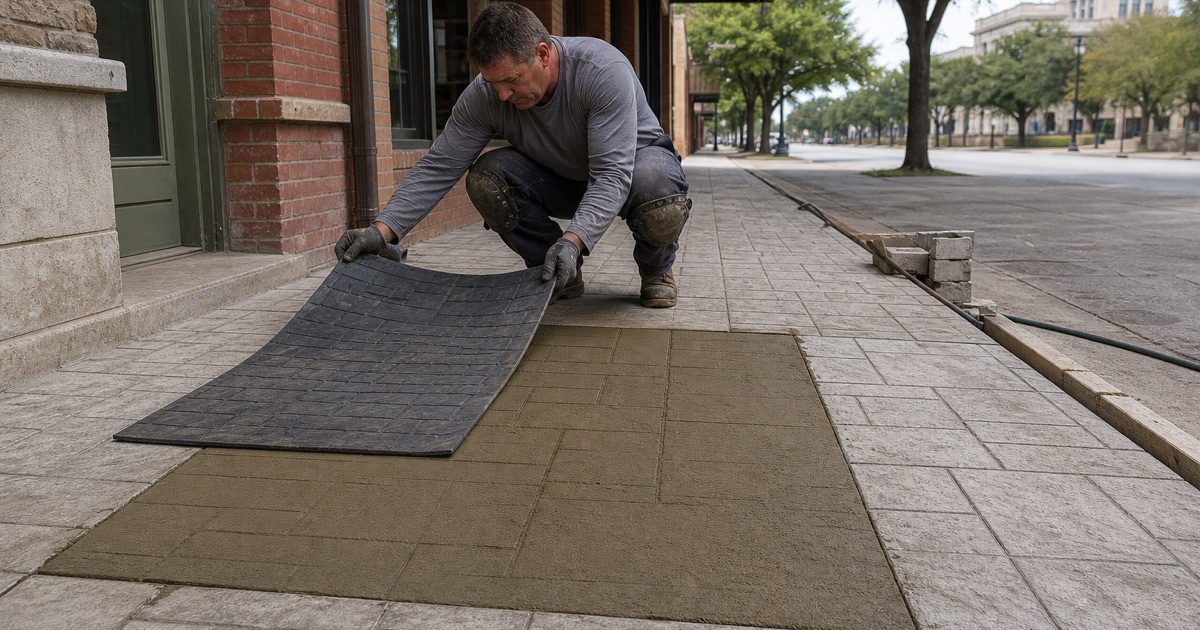
Stamped concrete is a single monolithic pour that is textured and colored while it is still plastic. Mats carrying a stone, brick, slate or plank relief are pressed into the surface with a release agent between them and the concrete, and the pattern, the color system and the joint layout all have to be decided before the truck arrives. There is no revising it afterward.
That front-loading is why the planning conversation matters more than the product list. We lay a pattern out against the actual elevation of the house, because ashlar slate and running bond brick sit comfortably beside the limestone and brick fronts common on properties here while a heavily grouted cobble reads as busy against them. We also plan the joints first, since concrete on smectitic clay with a plasticity index of 44 will move, and a stamped surface hides a sawcut far better than it hides a random crack.
Stamped Concrete Patterns and Textures
Ashlar Slate, Seamless Stone and Random Stone
Ashlar slate lays rectangular units in a repeating arrangement and is the most forgiving pattern to install cleanly, which is why it is the most common. Seamless stone skips the joint lines entirely and gives a continuous textured surface that reads as natural rock. Random stone falls between them, with irregular units and visible grout lines. Each of the three takes color differently, because a deeper relief holds more release agent in its low points.
Scale is the decision most people get wrong. A large-unit pattern on a small patio reads as two and a half stones, while a small pattern across a wide driveway turns into visual noise, so we size the unit to the slab rather than to the sample.
Running Bond Brick, Herringbone and Cobblestone
Brick patterns suit entries, walkways and borders, and they hold their proportion well at small sizes where stone patterns do not. Herringbone reads as more formal and works especially well as a border framing a field of something else. Cobblestone gives the most texture and the deepest grout lines of the common patterns. On a walkway that texture is welcome underfoot; on a wide field it can start to feel restless.
Deep relief has a cost worth knowing about before you choose it. The more aggressive the texture, the more it collects grit and the harder it is to sweep and reseal, which is a real consideration on a surface that gets used daily.
Wood Plank, Borders and Sawcut Detail
Plank stamps produce a board-textured surface that suits covered porches and outdoor kitchen areas, where a wood look is wanted without wood maintenance. Borders in a contrasting pattern or color frame a field and give the layout a deliberate edge rather than one that simply stops at the form. A border also gives the slab a natural place to change direction where the shape is irregular.
Sawcut detail is the cheapest design tool available on a stamped slab. Cutting the control joints along pattern lines or into a geometry of their own means the joints the slab needs anyway become part of the design instead of an interruption to it.
Color, Release Agents and Antiquing
Integral Color Through the Mix
Integral color pigments the entire load at the plant, so the color runs full depth and a chip or a saw cut exposes the same shade underneath. It produces the most uniform field and the most durable result, at the highest material cost, and it limits how deep or how saturated a shade you can practically reach. It is the sensible base layer under a release agent when the finished color needs to survive decades of wear.
Dry Shake Color Hardener and Release Agent
Dry shake hardener is broadcast onto the fresh surface and worked in, coloring the top layer while densifying it, which produces a harder wearing surface than the concrete underneath. The release agent that keeps the mats from sticking does double duty as a secondary color, settling into the low points of the texture. That interaction is where the depth in a good stamped job comes from. A single base color with a contrasting release reads as natural stone because the shading follows the relief, while one flat color across the whole field reads immediately as concrete pretending.
Acid Stain, Dye and Antiquing
Acid stain reacts chemically with the concrete rather than sitting on it, producing translucent, variegated color that ages well outdoors and never looks painted. Dye offers a far wider and more vivid range but is less stable in direct sun, which matters on an unshaded slab here. We choose the system by exposure rather than by preference. A covered porch can carry a dye that would fade on an open patio, and we say which surfaces on your property fall into which category before anything is ordered.
Where Stamped Concrete Works on a Central Texas Property
Patios, Outdoor Kitchens and Fire Pit Surrounds
Patios are where stamped concrete earns the most, because the surface is seen up close, the loads are light, and the shape is free. Around an outdoor kitchen or a fire pit we lean toward tighter textures that stay comfortable underfoot and clean easily, since a deeply relieved cobble around a cooking area collects everything that gets dropped on it.
Stamped Driveways, Walkways and Entries
A stamped driveway is the largest decorative surface a property can have, and it carries the heaviest loads, so the base work, thickness and reinforcement are identical to a plain drive and the pattern is chosen for durability. Entries and walkways are where a contrasting border does the most work, tying the drive, the walk and the porch together.
Pool Decks, Slip Resistance and Surface Heat
Around a pool the texture is a safety feature rather than a style choice, and a grit additive in the sealer raises slip resistance further on a wet surface. Color matters here too, because a darker slab absorbs more heat, and on an unshaded deck through a stretch running 101 to 103 degrees that difference is felt through bare feet.
Comparisons, Sealing and Long-Term Care
Stamped Concrete Against Pavers and Flagstone
Pavers and flagstone are individually set units. They can be lifted and reset where the ground moves, weeds find the joints, and the field is only as flat as its worst unit. Stamped concrete is one slab: it will not shift piece by piece, it has no joints for weeds, and it will crack where the ground insists, which is what the joint plan is for.
On expansive clay a monolithic slab with a properly spaced sawcut pattern usually stays flatter over time, while set units are more forgiving of movement and far easier to open for a utility. We price both when the choice is genuinely open rather than steering it.
Sealers, Sheen and Realistic Resealing
A film-forming acrylic is the usual choice on stamped work because it deepens the color and brings the pattern forward, and it is the sealer that needs periodic renewal. Penetrating silane and siloxane sealers protect without changing the look, at the cost of the wet, saturated appearance most people want from a stamped surface. Sheen runs from matte through satin to wet-look, and the higher the gloss the more obvious every scuff and wear path becomes. In this sun a film-forming sealer on an exposed slab is a recurring maintenance item, and it is better to know that going in than to discover it.
Cracks, Joints and Repairing a Stamped Surface
Repairs to stamped concrete are harder than repairs to plain concrete because color and texture both have to be matched, which is a strong argument for getting the joint layout right the first time. Cracks that follow a sawcut disappear into the pattern; cracks across a panel do not. Where a stamped surface has to be disturbed downtown, the rules are explicit: in the Central Area district a repaired or replaced sidewalk must go back at its previous width with any existing decorative pavers or stamped patterns repaired or replaced. We photograph and template before demolition so what goes back matches what came out.
- 20+ Years in Central Texas
- Bonded & City Registered
- Free Written Estimates